Updated June 2026

A new home in Maryland can pass inspection and still leak air at every penetration, miss its R-value targets after settling, and force the HVAC system to work harder than it was designed to. Why? Because often, “code compliant” and “actually efficient” aren’t the same thing.
Code compliance is a floor, not a ceiling, and new home insulation in Baltimore that only meets the minimum can cost owners more in monthly utility bills over the life of their home.
Maryland adopted the 2021 International Energy Conservation Code (IECC), effective May 29, 2024, raising envelope requirements statewide for new homes. Baltimore sits in IECC Climate Zone 4A , a mixed-humid climate insulation zone where cold winters and humid summers mean a home’s envelope works in both directions all year. With proper air sealing and insulation, homeowners can save an average of 15% on heating and cooling costs. These savings are far easier to capture during new construction than after drywall goes up.
Following four sequenced steps during construction — air sealing, insulating the attic, the walls, and then the basement/crawl space — closes the gap between code-minimum and genuinely efficient. Each step builds directly on the one before it. For a broader look, see these energy-saving steps for Maryland home builders.
Step 1: Air Seal First, Insulate Second
Why Air Sealing Comes First
Insulation slows heat flow, but it doesn’t stop air movement on its own. An uncontrolled air leak around top plates, recessed lights, or an attic hatch allows conditioned air to bypass insulation entirely. A home needs air sealing to fill in the tiny gaps and cracks. Heating and cooling account for over half of a home’s energy use. Proper insulation and air sealing together reduce energy costs and overall energy demand.
Air sealing for new homes in Maryland must be addressed during framing, before insulation goes in. In fact, Maryland’s Building Performance Standards require a verified air leakage rate of 3 ACH50 or less for Climate Zone 4A, as confirmed by a blower door test Maryland code requires at final inspection.
Where the Leaks Are and How to Fix Them
The most common leak points in new construction are:
- Top plates between framed walls and the attic floor
- Attic hatches, recessed lights, ceiling-mounted fans, and HVAC chases
- Around exterior doors and windows
- Electrical, plumbing, and HVAC penetrations through rim joists and top plates
- Where different materials meet, such as sill plate to foundation or drywall to floor
Caulk works for gaps of ¼ inch or less between rigid materials. Low expansion can foam handles gaps between ¼ inch and 3 inches around windows, doors, and penetrations. Attic hatches and exterior doors need weatherstripping and gaskets, while larger chases require rigid material plus sealant.
Step 2: Attic Insulation — R-49 is the Minimum, R-60 is the Ideal
Why the Attic Is Next
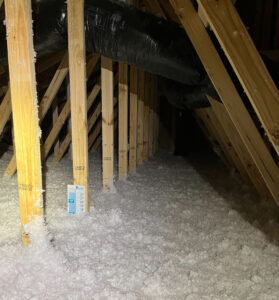 Heat rises, and the attic is the single largest source of heat loss in winter and heat gain in summer in a typical Maryland home. Once the attic floor (or roof deck in a conditioned attic) is properly air-sealed, attic insulation in Baltimore, Maryland homes delivers the biggest energy return of any envelope upgrade.
For climate zones 4A and 5A, state Building Performance Standards require a minimum insulation level of R-49 for attics in new Maryland homes, while the DOE recommends R-60 for maximum efficiency.
Material Options for a New Maryland Attic
Choosing the right approach for attic insulation services depends on the attic design.
Blown-in fiberglass or cellulose
Blown-in fiberglass or cellulose insulation applied on the attic floor is the most cost-effective way to reach R-49 to R-60 in a vented attic with adequate truss heel height.
Spray foam
Open-cell or closed-cell spray foam applied at the roof deck brings the attic into the thermal envelope, expanding the building envelope and helping maintain a more reasonable attic temperature.
Vented vs Conditioned Attic – Which is Right?
For new Maryland homes where HVAC and ductwork are in the conditioned living space, a vented attic with insulation on the attic floor is the most common and cost-effective approach. When HVAC equipment or significant ductwork is in the attic instead, a conditioned (unvented) attic with insulation applied at the roof deck is the better engineering choice. This is because bringing that equipment inside the thermal envelope reduces duct-related energy losses.
Step 3: Wall Insulation to Climate Zone 4A Targets
What Maryland’s 2021 IECC Requires
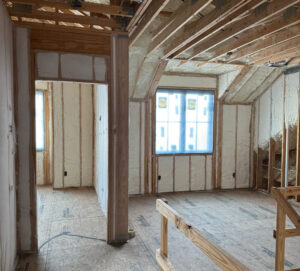 Under its adopted code, the wall insulation R-values Maryland targets for wood-frame walls in climate zone 4A are R-20 cavity or R-13 cavity plus 5 continuous insulation (ci). These Climate Zone 4A insulation requirements apply to all new residential construction across the Baltimore region. New construction has a real advantage over retrofits because cavities are open during framing, so any cavity strategy mentioned below can be installed cleanly without tearing out drywall or siding.
Choosing the Right Wall Material
Fiberglass batts
Fiberglass batts are the most cost-effective cavity option when installed without gaps, voids, or compression around plumbing and electrical.
Blown-in fiberglass or cellulose
A blown-in wall insulation system, dense-packed behind netting, fills cavities completely around obstructions and is a strong advantage in 2×6 framing where higher cavity R-values are needed.
Mineral wool batts
Mineral wool batts are naturally fire-resistant and hold their shape in Maryland’s coastal humidity. They also provide quality sound control between interior walls.
Spray foam insulation
Open-cell or closed-cell spray foam air seals and insulates in one step. This is especially valuable when wall geometry makes other materials difficult to install.
Step 4: Basement, Crawl Space, and Rim Joists
The Most Overlooked Step in a New Maryland Home
Basements, crawl spaces, and rim joists are consistently shortchanged during new construction, often because they are out of sight and many builders don’t consider insulating the concrete or masonry walls. In Maryland’s mixed-humid climate, skipping insulation at the basement and crawl space levels is a bigger problem than it would be in a drier climate. The same humid summer air that makes your AC work overtime also pushes moisture against the lowest parts of your home. Rim joists — the framing that sits on top of your foundation walls — are also one of the biggest spots where outside air sneaks in.
R-Value Targets and What to Install
Under Maryland’s Building Performance Standards, prescriptive targets for crawl space and basement wall insulation in Maryland climate zone 4A homes are R-13 or R-10i. For basements or crawl spaces that are not part of the conditioned envelope, R-19 batt or rigid foam should be installed under the floors above unconditioned spaces.
Closed-cell spray foam
Rim joist insulation in Baltimore is best handled with closed-cell spray foam insulation, which air-seals and insulates in one application while acting as a vapor retarder to protect against Maryland’s humid summers. For crawl space insulation in Maryland homes, an encapsulated approach with closed-cell spray foam on the walls controls both heat flow and vapor far better than exposed fiberglass batts in a vented crawl space, which can saturate and degrade over time.
Rigid foam board
Rigid foam board on the interior face of basement walls provides continuous R-value, resists ground moisture, and creates a thermal break between the concrete and the conditioned space.
Build It Right the First Time

Following the four steps of air sealing, insulating the attic, walls, and then the basement and crawl space work because they’re sequenced. Each step makes the next one perform at its designed R-value. Skipping any of them quietly undermines the rest of the thermal envelope. Remember, the most cost-effective time to meet or exceed Maryland’s 2021 IECC requirements is during framing, before drywall closes the cavities.
Homeowners and builders across the Baltimore region count on DeVere Insulation because we know the code, the climate, and the construction sequence to align your project’s envelope with the 2021 IECC and Climate Zone 4A performance targets. Contact us today at 410-360-6900 to schedule a free new-construction insulation evaluation. Our team proudly serves the Baltimore metro area, Maryland’s Eastern Shore, Southern Maryland, and the Piedmont.
References
ENERGY STAR. “Methodology for Estimated Energy Savings from Sealing and Insulating.” U.S. Environmental Protection Agency, www.energystar.gov/saveathome/seal_insulate/methodology.
ENERGY STAR. “Recommended Home Insulation R–Values.” U.S. Environmental Protection Agency, www.energystar.gov/saveathome/seal_insulate/identify-problems-you-want-fix/diy-checks-inspections/insulation-r-values.
Maryland Department of Labor, Division of Labor and Industry. “Maryland Building Performance Standards, COMAR 09.12.51.” Maryland Building Codes Administration, effective 29 May 2023, www.dllr.state.md.us/labor/build/comar091251.pdf.
Maryland Energy Administration. “Building Codes.” Maryland.gov, energy.maryland.gov/pages/policy-energy-codes.aspx.
North American Insulation Manufacturers Association. “Maryland Building Performance Standards: Summary of Key Residential Energy Code Requirements.” NAIMA, https://insulationinstitute.org/wp-content/uploads/2025/05/N103-MD-Energy-Code-0425.pdf.
U.S. Department of Energy. “Building America Climate-Specific Guidance.” Building America, https://www.energy.gov/cmei/buildings/building-america-climate-specific-guidance
U.S. Department of Energy. “Insulation.” Energy Saver, Office of Energy Efficiency & Renewable Energy, www.energy.gov/energysaver/insulation.
U.S. Department of Energy. “Minimizing Energy Losses in Ducts.” Energy Saver, Office of Energy Efficiency & Renewable Energy, www.energy.gov/energysaver/minimizing-energy-losses-ducts.
U.S. Energy Information Administration. “Use of Energy Explained.” EIA, https://www.eia.gov/energyexplained/use-of-energy/homes.php.
University of Maryland Extension. “Home Energy: Insulation.” University of Maryland, extension.umd.edu/resource/home-energy-insulation.
UpCodes. “Maryland Energy Code 2021.” https://up.codes/viewer/maryland/iecc-2021.