When many new homeowners in Maryland build their homes, they usually focus on square footage, finishes, and energy bills. What often gets overlooked is how insulation and air sealing choices made during construction can affect their family’s health for years to come.
The Environmental Protection Agency (EPA) says Americans spend about 90% of their time indoors, where pollutant concentrations can often be significantly higher than outdoor levels. Poor indoor air quality affects everyone, especially children, older adults, and people with asthma or heart disease.
This matters even more in Maryland’s mixed-humid climate. A poorly sealed home can let in pollen, dust, and outdoor pollutants while also trapping moisture where mold can grow. The EPA notes that indoor air pollutants can contribute to health effects such as eye, nose, and throat irritation, headaches, fatigue, respiratory disease, and other serious health concerns. The good news is that the right insulation and air sealing strategy can help create cleaner air, more stable temperatures, less noise, and better protection from outdoor contaminants from the day you move in.
Are you building a new home in Baltimore? If so, now is the time to get it right with insulation and air sealing. Although the Maryland building code enforces code minimums for new home insulation and energy efficiency, proper installation and air sealing are what unlock the real comfort and health benefits.
Improved Indoor Air Quality: Cleaner Air Starts with a Sealed Building Envelope
Indoor air pollutants come from many sources, including outdoor infiltration, mold, combustion byproducts, and building materials. Creating a tighter building envelope with proper insulation and air sealing is one of the best ways to support cleaner indoor air in a new build. When insulation and air sealing work together, they help block pollen, mold spores, dust, and other allergens from moving through gaps in walls, ceilings, and floors.
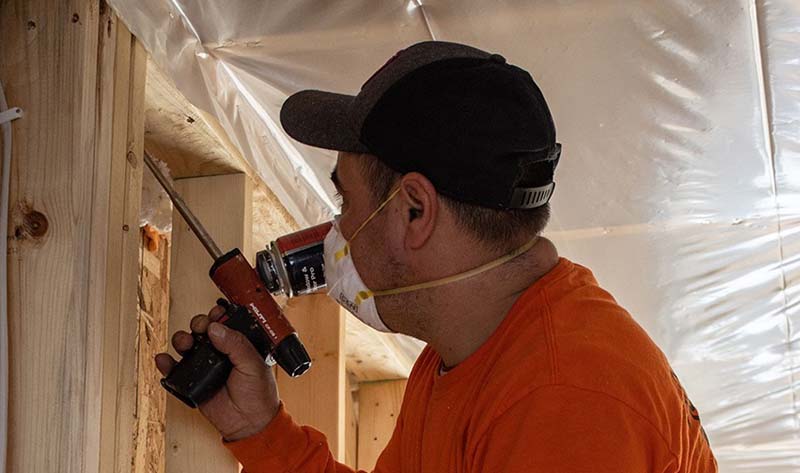
Moisture is another big issue in Maryland homes. Proper insulation and air sealing help control moisture infiltration and the conditions that fuel mold and mildew growth. It’s recommended to keep your indoor humidity below 60%, ideally between 30% and 50%, to help inhibit mold growth.
Spray foam insulation stands out as a top option for many builders and homeowners because it insulates and air seals in one step, creating a tighter, healthier home. It eliminates gaps that other insulation materials leave behind.
For the best results in indoor air quality, insulation and air sealing should be paired with proper mechanical ventilation, such as an Energy Recovery or Heat Recovery Ventilator System (ERV and HRV). This is a key step, along with source control and filtration, to improve indoor air quality, while letting your tight home breathe on its own terms.
Temperature Regulation and Comfort: A Healthier Home is a Temperature-Stable Home
Comfort is about more than lower utility bills. It’s also about protecting the people inside your home with consistent indoor temperatures. The U.S. Department of Energy confirms that insulation improves comfort by resisting heat flow. Here in Maryland, where our summers are hot and humid and our winters are cold, temperature regulation and insulation comfort become a real health and quality-of-life issue for vulnerable family members such as infants, older adults, and anyone sensitive to extreme temperature swings.
This is especially important if you are trying to create an energy-efficient new home that feels comfortable year-round without overworking your HVAC system. ENERGY STAR reports that homeowners can save an average of 15% on their heating and cooling costs by air sealing and adding insulation. Less strain on your HVAC system can also mean quieter operation and longer equipment life.
Noise Reduction: A Quieter Home for Better Health and Sleep
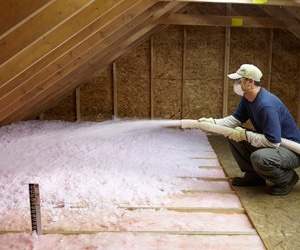
Insulation also helps create a quieter indoor environment by filling building cavities to reduce airflow and noise transmission. For homes near traffic, active neighborhoods, or ongoing development, installing noise reduction insulation in your new home can make a noticeable difference in your sleep, stress, and overall peace of mind.
Fiberglass batts, mineral wool, and spray foam can all help with sound control, depending on where they are installed. For many new homes, fiberglass insulation remains a practical and cost-effective option for improving comfort while also helping reduce sound transfer between rooms and from outside.
Protection From Outdoor Toxins: Insulation and Air Sealing Work as a Shield Against Pollutants
Good insulation and air sealing not only keep conditioned air inside, but they also help limit the paths that outdoor pollutants use to get in. Outdoor contaminants, including radon, pesticides, and particulate matter, can enter your home through cracks and openings in the building envelope. Sealing areas like sill plates, rim joists, and around plumbing or electrical penetrations during construction helps block these entry points before the walls are closed up.
A well-sealed home can better protect against vehicle exhaust, dust, pollen, and other outside pollutants while still supporting healthy ventilation. Weatherization measures, such as adding insulation and air sealing, can improve your home’s energy efficiency without sacrificing indoor air quality when they are paired with proper ventilation strategies. New construction is the ideal time to get both right. It’s far easier and more affordable to seal your home during construction than after the fact.
Frequently Asked Questions: A Recap
Q: How does insulation improve indoor air quality in a new home?
A: It helps reduce gaps where dust, pollen, and other pollutants can enter, especially when paired with air sealing and proper ventilation.
Q: What type of insulation is best for indoor air quality in new construction?
A: Spray foam is often chosen because it insulates and air seals in one application, though other products can also perform well when paired with an air sealing plan.
Q: Does insulation help prevent mold in a new Maryland home?
A: Yes. Proper insulation and air sealing help control moisture, which reduces the conditions mold needs to grow. In Maryland’s humid climate, insulation, air sealing, and proper ventilation all play an important role.
Q: What insulation does Maryland’s building code require for new homes?
A: Maryland uses the 2021 IECC, in which Baltimore follows the IECC Climate Zone 4A requirements. New homes typically need minimum insulation levels like R-38 in ceilings, R-13 in wood-frame walls, R-19 in floors, and R-10 in basement walls. These are minimums, and going beyond them can improve both efficiency and comfort.
Q: Can insulation reduce noise in my new home?
A: Yes. Insulation helps reduce sound transfer between rooms and from outside. Fiberglass, mineral wool, and spray foam all offer sound-control benefits depending on the application and assembly design.
Enjoy a Comfortable and Healthy Home with Proper Insulation
The health benefits of proper insulation and air sealing go far beyond lower energy bills. Cleaner air, steadier indoor temperatures, less noise, and better protection from outdoor pollutants all add up to a healthier home from day one. For both homeowners and builders, new construction is the best time to make smart insulation decisions, as retrofitting later can be disruptive and expensive.
Since 1987, DeVere Insulation has partnered with Baltimore-area builders and homeowners to create homes that are comfortable, efficient, and built to perform. If you’re planning a new build and want a team that understands local code, proven insulation systems, and the value of getting insulation and air sealing right from the start, contact us today to get started.
References
Maryland Energy Administration. “Building Codes.” State of Maryland, http://energy.maryland.gov/pages/policy-energy-codes.aspx.
National Renewable Energy Laboratory. “Maryland Residential Energy Efficiency Potential.” ResStock, U.S. Department of Energy, http://resstock.nrel.gov/factsheets/MD.
U.S. Department of Energy. “Insulation.” Energy Saver, www.energy.gov/energysaver/insulation.
U.S. Environmental Protection Agency. “Energy, Weatherization and Indoor Air Quality.” EPA, www.epa.gov/indoor-air-quality-iaq/energy-weatherization-and-indoor-air-quality.
U.S. Environmental Protection Agency. “Improving Indoor Air Quality.” EPA, www.epa.gov/indoor-air-quality-iaq/improving-indoor-air-quality.
U.S. Environmental Protection Agency. “Indoor Air Quality.” Report on the Environment, www.epa.gov/report-environment/indoor-air-quality.
U.S. Environmental Protection Agency. “The Inside Story: A Guide to Indoor Air Quality.” EPA, www.epa.gov/indoor-air-quality-iaq/inside-story-guide-indoor-air-quality.
U.S. Environmental Protection Agency. “Why Seal and Insulate?” ENERGY STAR, www.energystar.gov/saveathome/seal_insulate/why-seal-and-insulate.