Updated May 11, 2026
Batt insulation in Baltimore homes is one of the most common insulation types found in walls, attics, and floors. But many older homes throughout the Baltimore metro area still have batt insulation that is not enough for today’s code requirements or compressed from decades of settling, quietly reducing energy performance with every heating and cooling season.
Baltimore sits in Climate Zone 4A (Mixed-Humid), which means homes face both cold winters and humid summers and is a designation that carries specific minimum R-values for walls, attics, and floors under Maryland’s 2021 IECC adoption. Homes that don’t meet those minimums pay a thermal penalty every month in higher energy bills and inconsistent comfort. When batt insulation isn’t performing properly, heat escapes during winter and infiltrates during summer, forcing your HVAC system to work harder year-round.
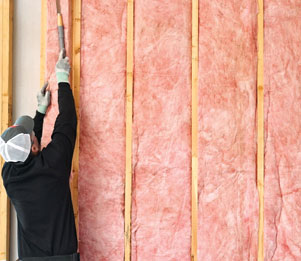 Batt insulation is a pre-cut form of insulation made from fiberglass or mineral wool, designed to fit between framing members like wall studs and ceiling joists. According to the U.S. Department of Energy, it remains one of the most widely used residential insulation types in the country. In Maryland’s 2021 IECC, Baltimore homes are required to meet minimum insulation levels like R-49 in attics and R-13 + R-5 continuous insulation (or R-20 cavity) in walls. Choosing the right material, the right R-value, and ensuring proper installation is what separates insulation that performs from insulation that simply fills space.
Not sure whether your home’s insulation still meets code — or ever did? A professional assessment can identify exactly where your home is losing energy.
What Batt Insulation Is and How It Works
Most common insulation materials work by slowing conductive and convective heat flow. An insulating material’s resistance to heat flow is rated by its R-value- the higher the R-value, the better the performance. Batt insulation is the most widely used insulation material used in U.S. homes. It comes in pre-cut sections designed to fit standard framing widths, typically 16″ or 24″ on center, and works by slowing the movement of heat through walls, ceilings, and floors. There are two primary materials used in batt insulation:
- Fiberglass batt insulation Maryland homes commonly use ranges from about R-2.9 to R-3.8 per inch
- Mineral wool batt insulation typically ranges from R-3.0 to R-4.2 per inch
Batts may be faced (with a kraft paper or foil vapor retarder) or unfaced, depending on where they’re installed and how moisture needs to be managed.
One critical detail often overlooked: compression kills performance. If batt insulation is compressed, cut poorly, or installed with gaps, it will not deliver its labeled R-value. The Department of Energy confirms that proper fit, without voids or compression, is essential for real-world performance.
Another factor is thermal bridging. The DOE notes that the overall R-value of a wall or ceiling will be somewhat different from the R-value of the insulation itself because heat flows more readily through studs, joists, and other building materials. This is called thermal bridging. In standard 2×4 framing at 16″ on center, thermal bridging can reduce the effective whole-wall R-value by roughly 20%, making continuous insulation especially valuable in walls.
Fiberglass vs. Mineral Wool — Which Is Right for Baltimore?
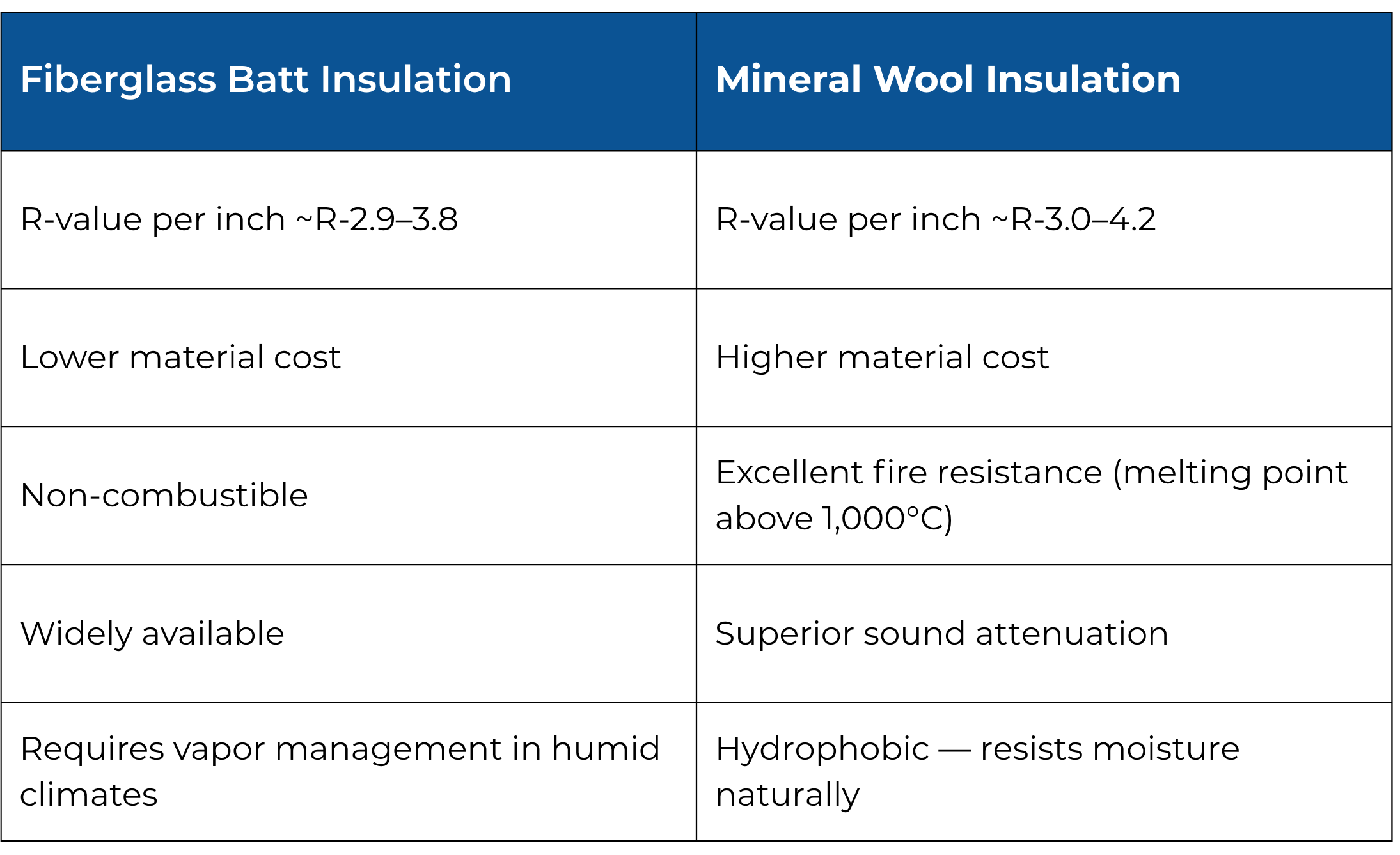 When choosing batt insulation Baltimore contractors typically decide between fiberglass and mineral wool. Both can meet Maryland code requirements, but they perform differently. The ENERGY STAR Insulation Fact Sheet notes that both fiberglass and mineral wool are effective insulation materials and that proper installation, not just material selection, is the primary determinant of real-world performance.
Baltimore’s mixed-humid climate makes this choice more important. Climate Zone 4A means both meaningful heating loads during cold, occasionally severe winters and significant cooling loads during humid summers, meaning insulation must perform in both directions. Vapor management is critical in mixed-humid climates: improper batt installation can trap moisture within wall cavities, increasing mold risk.
Mineral wool’s hydrophobic properties make it especially well-suited to areas prone to moisture exposure such as rim joists and below-grade walls.
R-Values Baltimore Homes Need — By Location
Understanding batt insulation R-value Climate Zone 4A requirements is critical if you want real energy savings.
Under Maryland’s 2021 IECC (enforced statewide beginning in 2024), Baltimore homes must meet these minimums:
- Attic / Ceiling: R-49
- Wood-frame walls: R-13 + R-5 continuous insulation or R-20 cavity
- Floors over unconditioned space: R-19
- Basement / foundation walls: R-10 (continuous) or R-13 (interior)
ENERGY STAR recommendations align closely with these values but focus on cost-effective performance for existing homes.
- Attic (uninsulated): R-60
- Attic (already has 3–4 inches): R-49
- Floors: R-19
- Wall sheathing: Add R-5 to R-10 CI when re-siding
- Basement/crawlspace wall: R-10 or R-13 batt
Many older homes fall short, especially in attics where insulation may have settled or degraded over time.
The DOE confirms that the 2021 IECC generates an estimated 9.38% site energy savings and 8.66% energy cost savings nationally compared to the 2018 IECC, meaning homes still insulated to older standards are likely leaving measurable savings on the table.
If you’re unsure where your home stands, professional residential insulation services can help identify gaps and recommend upgrades.
Why Professional Installation Is Non-Negotiable
 Even the best insulation won’t perform if it’s installed poorly. The DOE notes directly that insulation that is compressed will not provide its full rated R-value, and that insulation filling building cavities reduces air leakage, but only when properly installed
Small gaps, misaligned batts, or compressed material can significantly reduce effectiveness. A single gap can create a thermal bypass, allowing heat to move freely through your home’s envelope.
Installation mistakes can also lead to moisture issues. For example:
- Installing kraft-faced batts in the wrong direction can create moisture problems within wall assemblies in humid climates like Baltimore.
- Overfilling cavities (like forcing R-19 into a 2×4 wall), which compresses the material and reduces its actual thermal performance below the R-13 rating for that space.
- Leaving voids around wiring, pipes, or edges can create a thermal bypass that dramatically reduces the assembly’s effective R-value.
Maryland building code also requires proper documentation of installed insulation, including type, manufacturer, and R-value. Professional contractors are equipped to meet these requirements and ensure compliance. Attic insulation installation in Maryland is often best left to the pros.
Frequently Asked Questions
Q: What R-value does batt insulation need to be in Baltimore, MD?
A: In Climate Zone 4A, Maryland’s 2021 IECC requires R-49 for attic assemblies, R-13 + R-5 continuous insulation (or R-20 cavity) for exterior wood-frame walls, and R-19 for floors over unconditioned spaces. Homes built before 2023 may fall short of these thresholds.
Q: Is fiberglass or mineral wool batt insulation better for a Baltimore home?
A: Both materials can meet Maryland’s 2021 IECC R-value requirements. Fiberglass is more widely available and cost-effective for standard wall cavities. Mineral wool offers superior fire resistance and moisture management, making it a strong choice for rim joists, below-grade applications, and areas where sound attenuation matters. The right choice depends on where in the home it’s being installed and your performance priorities.
Q: Can compressed batt insulation still meet its rated R-value?
A: No. The DOE confirms that compressed insulation will not provide its full-rated R-value. Batts must fill their cavity without being forced into a space smaller than their design thickness, and without gaps or voids at the edges.
Q: Does replacing batt insulation require a permit in Baltimore?
A: Adding or replacing insulation typically does not require a permit in Baltimore City or Baltimore County, but any work that modifies the thermal envelope of a building — especially in new construction or major renovation — must comply with the 2021 IECC and may trigger inspection. Always verify with your local building department. Maryland code does require installers to provide documentation of installed R-values.
Q: What is the difference between batt and blown-in insulation?
A: Batt insulation comes in pre-cut sections installed between framing members during open-wall construction or renovation. Blown-in insulation is loose-fill material (cellulose or fiberglass) pneumatically installed — ideal for attics, enclosed cavities, and retrofit applications where batt installation isn’t feasible. Many Baltimore homes benefit from a combination of both.
Batt Insulation for Your Baltimore Project
Batt insulation Baltimore builders choose remains one of the most cost-effective and versatile insulation solutions available, but only when it’s the right material, the right R-value, and installed correctly.
With Maryland’s updated energy code raising the bar, many homes no longer meet minimum performance standards. The difference between insulation that looks right and insulation that actually performs comes down to installation quality and expertise. Whether you’re insulating new construction or upgrading an existing home, the difference between insulation that looks right and insulation that performs is in the installation, and that requires professional expertise.
Contact DeVere Insulation today to schedule a professional insulation assessment. Maryland’s largest independent insulation contractor, our team ensures every batt installation meets the 2021 IECC requirements for your climate zone, so you get comfort, energy savings, and code compliance in one visit. Call 410-360-6900 or contact us now to get started.
References:
Maryland Energy Administration. “Building Energy Codes.” State of Maryland, energy.maryland.gov/pages/policy-energy-codes.aspx.
Maryland Department of Labor. “Maryland Building Codes.” Division of Labor and Industry, Building Codes Administration, www.labor.maryland.gov/labor/build/buildcodes.shtml.
U.S. Department of Energy. “Insulation.” Energy Saver, www.energy.gov/energysaver/insulation.
U.S. Department of Energy. “Energy-Efficient Home Improvement Credit: Insulation and Air-Sealing Essentials.” Office of Clean Energy Demonstrations, www.energy.gov/cmei/buildings/articles/energy-efficient-home-improvement-credit-insulation-and-air-sealing.
ENERGY STAR. “Recommended Home Insulation R-Values.” U.S. Environmental Protection Agency, www.energystar.gov/saveathome/seal_insulate/identify-problems-you-want-fix/diy-checks-inspections/insulation-r-values.